How do companies license their internal data to AI labs?
Quick answer, updated
Companies license internal data to AI labs in seven steps: check that the company qualifies and owns the records, describe the data without sending it, get a price after the buyer reviews it, sign before the full copy moves, deliver the copy, pass the buyer’s acceptance review, and get paid. Of the 25 buyers in the Data Licensing Index that say how data reaches them, 16 accept a copy you export yourself and 11 can connect to your tools (4 accept either). Payment follows a trigger the contract names: Appen and Centific pay on acceptance rather than submission, and micro1 has 30 days to review the data before you invoice. Mode expects about three months from the first conversation to payment.
By David Persson, editor of Data Licensing Index.
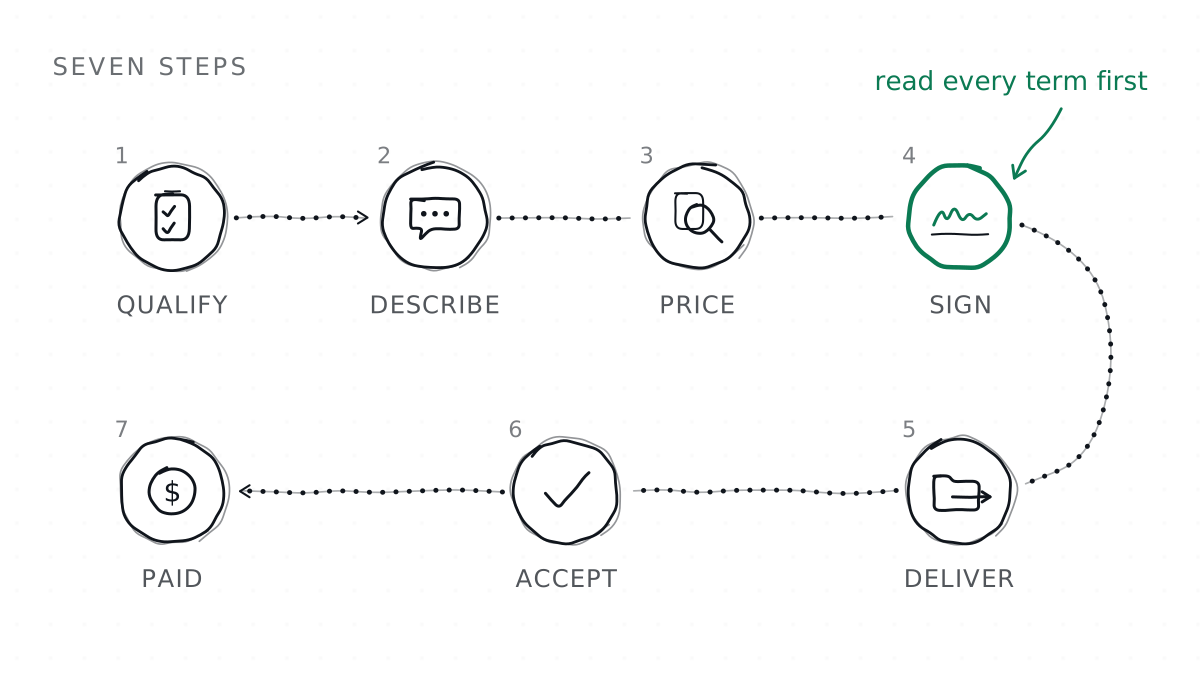
Seven steps from first call to payment. Read every term before step 4; after you sign, the contract decides.
The seven steps at a glance
- Check that you qualify and own the records. Size and history rules, and whether you may license what the records contain.
- Describe the data, without sending it. Which systems, how many years, how many people.
- Get a price after the buyer reviews it. A figure for your records, made after a sample, an audit or a scoping pass.
- Sign before the full copy moves. Price, scope, exclusivity, who de-identifies and what triggers payment.
- Deliver the copy. Your own export, the buyer’s read-only connector or its API, with personal information removed.
- Pass the buyer’s acceptance review. At several buyers, payment waits for acceptance.
- Get paid and close out. Payment on the agreed trigger, then deletion of the raw copy, any refresh and the end of access.
Who you sign with matters at every step. The buyers in the index are mostly companies that supply AI labs rather than labs themselves: 27 AI data companies and 17 brokers or intermediaries among 51 listings. Broker or direct buyer explains how each kind gets paid.
1. Check that you qualify and own the records
15 of the 51 buyers publish a minimum company size, and the rules vary. Handshake AI wants “20+ full time employees & 3+ years in operation”. Mode asks for “6+ for legal; 10+ for accounting, finance, and medical; 30+ for all other businesses or nonprofits.” SuperAnnotate takes “Any size, any industry, anywhere” as long as you have “records built up over time and the rights to license them.” The size guide lists every published minimum.
You can license only what the company owns and may lawfully hand over. Employee email and chat from EU, UK or Canada-based staff, and client records from law, accounting, tax or health firms, need extra care, usually consent or anonymization. Customer contracts, privacy notices and vendor licenses can rule records out. If the company is closing, the board, investors or a trustee may have to approve the deal (who decides). Have counsel review the rights before you sign anything.
2. Describe the data, without sending it
The first contact is about the company, not its files. Maryah asks for “Your team size, sector, tools and record history. No files or system connections.” Polyshares: “Intake asks for record counts, not files or exports.”
Send a description: which systems you used, for how many years, how many people worked in them, and what you will not license. Keep credentials, raw exports and files with personal information back until a contract says who receives them. Our free value check asks the same questions and returns the buyers that fit; we never ask for data.
3. Get a price after the buyer reviews it
A figure on a buyer’s website is what it says it may pay. A price for your company comes after the buyer has looked at what you have. Ooak Data: “We never quote a number before counting. The estimator gives a range; the audit gives a figure.” Anthroly: “Every record is priced individually, after we have read a de-identified sample.” Aribase says “the final price is set in the written license agreement”, and Grepped’s terms say “Estimates on the site are indications, not offers.”
Ask for the figure in writing, with the scope it covers. What company data is worth sets the published ranges beside the deals that have been reported.
4. Sign before the full copy moves
Several buyers put the written agreement before the export. Appen: “Terms are agreed in writing before extraction begins”. Mode: “Your written agreement sets the amount and payment schedule before export.” Polyshares: “Nothing leaves your systems until Polyshares has made an offer and you have accepted it.” A de-identified sample can move earlier: Anthroly prices after reading one, and at Troveo “Buyers evaluate your data anonymously and are confidentially introduced only after an agreement is signed.” Ask any buyer whose pages do not say so which comes first.
Read four terms before you sign:
- Scope. Which systems, which years, what is excluded.
- Right granted. A license or a sale. Appen says “You keep ownership”, while FileYield also offers a “one-time sale” and Centific offers companies winding down “a dedicated asset-purchase agreement”.
- Exclusivity. SourceX licenses are “exclusive for AI training”, Labelbox Prism’s are “exclusive by default”, and pre.dev is “Non-exclusive by default”.
- Payment trigger. Signature, delivery or acceptance (step 6).
Until you sign, the buyers that address it let you walk away. Labelbox Prism: “No commitment required. Scoping is free and non-binding”. SuperAnnotate lets you approve each buyer of your data, “and can block competitors permanently.” Some commitments come before any license. AI Training Data Broker: “When we find an interested buyer or AI lab for your data, we ask for a 3-month exclusive broker agreement”. FileYield’s seller agreement says you “may not circumvent FileYield’s fees by agreeing to a deal off-platform with a buyer you first met through FileYield.” Read a broker or platform agreement as closely as the license. The offer checklist covers every clause, and our free offer review reads an offer for you.
5. Deliver the copy
Data reaches a buyer in one of three ways: you export the files and hand over a copy, the buyer connects to your tools, or you transfer through its API. Among the 25 buyers in the index that say which:
| How data moves | Buyers |
|---|---|
| You export the files and hand over a copy (12) | Nyne, Troveo, AI Training Data Broker, AI26, AIData.Broker, Databounties, Korra, Longitude Labs (Data licensing desk), Maryah, Montlake Licensing, SourceX, Telegraph Lab |
| Either your export or the buyer’s connector (4) | Labelbox Prism, Ooak Data, DataVendor, The General Data Company |
| The buyer connects to your tools (connector or OAuth) (7) | Appen, Centific, Mercor, Mode (BizBuyData), pre.dev (code licensing), Grepped, Scrimdata |
| You transfer through the buyer’s API or another approved method (2) | micro1, Sanctus Data Labs |
| Not published (26) | 26 buyers, listed in the index |
In the buyers’ words:
- Your export. Troveo: “No OAuth into your systems. No platform to install. We guide you through the export and handle the anonymization, packaging, and every buyer conversation.”
- Their connector. Centific: “Read-only access across 188 supported enterprise applications. You choose which ones, and you set the exclusions.” Mercor: “Choose from 100+ supported tools and link your accounts.” Mode: “Your team reviews it and signs in to the approved systems; no passwords are handed over.”
- Their API. micro1: “You securely transfer your data through our APIs or other approved methods.”
Platform terms can decide the route. Google’s Workspace API policy bars apps from using user data from its restricted and sensitive scopes to train a machine learning or AI model beyond that user’s personalized model. Slack’s API terms bar the provider of an app offered outside its own organization from using API data to train a large language model or bulk exporting message and file data, except where an additional agreement allows it. A company’s own admin export is a different route, and whether licensing that export is allowed under your agreement with Google or Slack is a question for counsel. The index explains the platform terms. Our guides to exporting Slack and Google Workspace cover the export side.
Who removes personal information, in the buyers’ words:
| Buyer | Who de-identifies, and where |
|---|---|
| Scale AI | “Scale anonymizes everything inside your environment, before any data is extracted.” |
| AIData.Broker | “your records are de-identified on your own computer to a published standard” |
| Mercor | “Our platform extracts and de-identifies data into an asset.” |
| Mode | “Mode removes sensitive material and transforms personal identifiers in the agreed copy” |
| Polyshares | “removed or replaced by a specialist PII partner before Polyshares or any buyer sees the record” |
| FileYield | “You handle the data transfer, PII handling, and compliance directly with the buyer” |
Korra’s page states the limit: “Removing names does not make records anonymous”. Agree the standard and who carries the risk if it falls short.
6. Pass the buyer’s acceptance review
At Appen, Centific, micro1, Nyne, Polyshares and SourceX, payment follows the buyer’s review or acceptance rather than delivery. Centific: “Paid on acceptance rather than submission.” micro1 “has 30 days to review and approve” what you transfer. Nyne: “Once your dataset is delivered and accepted, you receive payment as outlined in your partnership agreement.” SourceX: “Data that does not reach Closing earns no payment.”
Before you sign, get in writing what the acceptance test is, how long the buyer has to run it, and what happens if part of the data is rejected. The offer checklist covers payment triggers.
7. Get paid and close out
When the seller is paid, in the buyers’ own words:
| Buyer | When you are paid |
|---|---|
| Mercor | “upon delivery of the anonymized dataset to the buyer”, typically “within 2-4 weeks of the signed agreement” |
| micro1 | After approval, “within 30 days of invoicing” |
| pre.dev | “Net 15 after funds land” |
| Labelbox Prism | “an upfront licensing fee at signing plus a revenue share on downstream use” |
| Polyshares | “Net 30 to 60 once the data is approved, anonymized, and delivered” |
| SourceX | “within 60 calendar days after SourceX receives a valid invoice, unless different terms are signed” |
| Corpus Data | “Intake to wire 30 – 60 days” |
| Longitude Labs | “Payment by wire, usually within 10 days of the intro call” |
End to end, Mode “generally expects about three months from the first conversation through payment.” micro1’s pages give two triggers, “within 30 days of acceptance” in its process and “within 30 days of invoicing” in its answers, so confirm which one the contract uses.
Settle three things at close-out. First, a deadline for deleting the raw copy: Ooak Data commits to deletion “within 30 days of delivery” (retention and deletion clauses). Second, whether deliveries recur: Centific says “Most partners then move to a quarterly refresh”, while Turing offers “One payment. No retainer, no recurring commitment.” Third, the end of any access: Grepped says its read-only access “is revoked when the project ends.”
Where we fit
The free value check covers steps 1 and 2 with you: an estimated range, the buyers that fit and the terms to watch. No buyer hears from you until you approve it, and we never touch your data. A buyer may pay us a referral fee when a company we introduced signs, and any buyer that does is named before an introduction (how we make money).
How this guide was built
Every buyer quote comes from the buyer records behind the index and was re-read on the buyer’s live page on November 2, 2026; the platform lines come from Google’s and Slack’s own terms. The counts and the ingestion table are computed from the index’s ingestion field at build time, and a buyer that does not say how it takes in data counts as not published. We have not verified any buyer’s process, and the order of steps at a given buyer is set by its contract.
Frequently asked questions
How long does it take to license company data to an AI lab?
Weeks to months, by the buyers’ own figures. Mode expects about three months from the first conversation through payment. Corpus Data gives 30 to 60 days from intake to wire, and Mercor says payment typically comes within 2 to 4 weeks of the signed agreement, depending on data extraction and processing time.
Do we have to give the buyer access to our systems?
Not with every buyer. Of the 25 buyers in the index that say how data reaches them, 12 take only a copy you export yourself, 7 only connect to your tools and 4 accept either. Connectors can be read-only: Centific offers read-only access where you choose the applications and set the exclusions, and Labelbox Prism offers read-only connectors. Ask which route each system takes before you sign, because platform API terms can matter.
Who removes personal information before the data is used?
It depends on the buyer. Scale AI anonymizes inside your environment before anything is extracted, AIData.Broker has records de-identified on your own computer, Mercor’s platform extracts and de-identifies the data, and Mode transforms personal identifiers in the agreed copy. FileYield leaves personal-data handling to the seller and buyer. Get the method, the standard and who carries the risk in writing.
When does the company get paid?
When the trigger in the contract is met. Appen and Centific pay on acceptance rather than submission, micro1 pays within 30 days of invoicing after it approves the data, and SourceX within 60 days of a valid invoice. Mercor pays on delivery of the anonymized dataset to the buyer. Labelbox Prism pays an upfront fee at signing plus a revenue share.
Does the company sell its data or keep it?
It depends on the contract. Appen says ‘You keep ownership’, Troveo that ownership never transfers, and Turing ‘You retain ownership of your underlying data.’ FileYield also offers a ‘one-time sale’, and Centific offers companies winding down ‘a dedicated asset-purchase agreement’. Check which right your contract grants, and for how long.
Can we back out after we see a price?
With the buyers that say so, yes, until you sign. Labelbox Prism says scoping is free and non-binding, and Polyshares says nothing leaves your systems until it has made an offer and you have accepted it. Some commitments come earlier: AI Training Data Broker asks for a three-month exclusive broker agreement once it finds an interested buyer.
How much is a company's data worth?
The 25 buyers in the index that publish a whole-company dollar range have a median range of $100K to $2M. Reported deals sit lower: SimpleClosure told Forbes its shutdown deals paid $10,000 to $100,000 per company. A price for your company comes after a buyer reviews the data.
Can a company that has shut down still license its data?
Often, if the legal entity still exists, someone can sign for it and the data was exported before the tools were canceled. Ooak Data says it has closed deals signed by a director, a liquidator or an administrator, and Turing acquires from teams winding down or already closed.
Is it legal to license our company's internal data?
It depends on what the records contain, where the staff and customers are, your customer contracts and privacy notices, and the platforms the data sits on. Employee email and chat from EU, UK or Canada-based staff and client records from law, accounting, tax or health firms need extra care, usually consent or anonymization. Have counsel review before you sign.
Sources
- 1.Data Licensing Index buyer records, each figure with a source quote on the buyer's page Accessed .
- 2.Handshake AI: license your data Accessed .
- 3.Mode (BizBuyData) (link withheld: company identity not independently corroborated) Accessed .
- 4.SuperAnnotate: data partnerships Accessed .
- 5.Maryah: business data (link withheld: company identity not independently corroborated) Accessed .
- 6.Ooak Data: partner page Accessed .
- 7.Anthroly (link withheld: company identity not independently corroborated) Accessed .
- 8.Aribase (link withheld: company identity not independently corroborated) Accessed .
- 9.Grepped: terms and security pages (link withheld: company identity not independently corroborated) Accessed .
- 10.Appen: enterprise data Accessed .
- 11.Troveo: business data Accessed .
- 12.Centific: enterprise data Accessed .
- 13.Mercor: data partnerships Accessed .
- 14.micro1: data partnerships Accessed .
- 15.Scale AI: data partnership Accessed .
- 16.Polyshares: home and data handling (link withheld: company identity not independently corroborated) Accessed .
- 17.AIData.Broker (link withheld: company identity not independently corroborated) Accessed .
- 18.FileYield: how it works and seller agreement (link withheld: company identity not independently corroborated) Accessed .
- 19.Korra: how it works (link withheld: company identity not independently corroborated) Accessed .
- 20.Nyne: data partnerships Accessed .
- 21.SourceX: how it works (link withheld: company identity not independently corroborated) Accessed .
- 22.pre.dev (link withheld: company identity not independently corroborated) Accessed .
- 23.Labelbox Prism Accessed .
- 24.Corpus Data (link withheld: company identity not independently corroborated) Accessed .
- 25.Longitude Labs (Data licensing desk) (link withheld: company identity not independently corroborated) Accessed .
- 26.Turing: Project Lazarus Accessed .
- 27.AI Training Data Broker: contact (link withheld: company identity not independently corroborated) Accessed .
- 28.Google for Developers: Google Workspace API User Data and Developer Policy Accessed .
- 29.Slack API Terms of Service (effective Oct 10, 2025) Accessed .
- 30.Gizmodo: Failed companies are selling old Slack chats and email archives to train AI (Apr 17, 2026), summarizing Forbes Accessed .
What is your company’s data worth?
Answer a few questions about the company. We reply with an estimated range, the buyers that fit and the contract terms to watch. Free for sellers, and we never ask for data, credentials or exports.