How much is your company's data worth to AI labs?
Quick answer, updated
The 25 buyers in the Data Licensing Index that publish a whole-company dollar range have a median range of $100K to $2M, and $50K to $1.5M among those whose size rules do not exclude a 10-person company. Reported deals sit lower: SimpleClosure’s nearly 100 shutdown deals in the year to April 2026 paid $10,000 to $100,000 per company. The largest public figure, Google’s $10 million bid for Spirit Airlines’ records, still needs court approval. A published range is what a buyer says it may pay. Your own figure comes in writing after a buyer reviews samples, and what you keep depends on fees, the payout model, exclusivity and what triggers payment.
By David Persson, editor of Data Licensing Index.
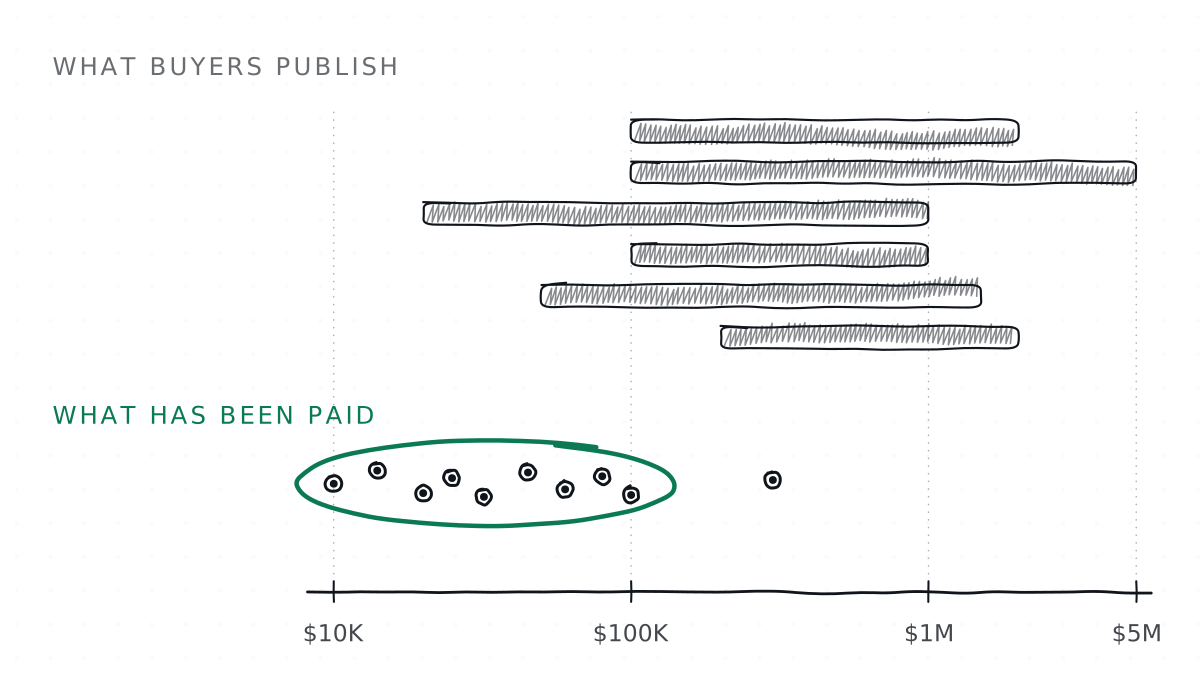
Buyers’ published ranges sit above most of the deals that have been reported. The bars and dots are illustrative and not tied to any buyer or deal.
Four figures that get called “what your data is worth”
Four different numbers circulate, and only one of them is about your company:
- Published range. Set by the buyer on its own website, before any contact. It is what the buyer says it may pay a company it would take. The median across the index is $100K to $2M.
- Estimate. Produced instantly by a calculator, such as our estimator. It shows where a company of your size and history falls among the published ranges. Nobody is committed to it.
- Written offer. Set by one buyer after it reviews samples or audits the data. It is the only figure about your own records. Read it with its fee, exclusivity and payment trigger.
- Paid deal. What changed hands after acceptance or delivery. Few are published, and most of what has been reported comes from shutdowns.
Buyers describe their own figures the same way. Ooak Data: “We never quote a number before counting. The estimator gives a range; the audit gives a figure.” Mercor publishes no range and says: “Compensation is based on data volume, the tools you connect, and the depth of your data.”
What the index shows, by company size and tier
The table summarizes every whole-company dollar range in the index the way the value estimator does: the median range runs from the middle of the published floors to the middle of the published tops. A size row counts every buyer whose published headcount rules do not exclude a company of that size, including buyers that publish no rule. It is computed from the index each time a row changes.
| Buyers counted | Median range |
|---|---|
| Whole index: 25 of 51 publish a range | $100K to $2M |
| Established tier: 9 of 19 publish a range | $100K to $1M |
| New tier: 16 of 32 publish a range | $100K to $2M |
| No size rule excludes 10 people: 14 of 38 publish a range | $50K to $1.5M |
| No size rule excludes 20 people: 19 of 44 publish a range | $100K to $2M |
| No size rule excludes 30 people: 22 of 48 publish a range | $100K to $2M |
Reading the table, as of October 2026:
- By size. 38 of the 51 buyers publish no minimum that excludes a 10-person company, most because they publish no size rule at all: 36 of the 51 publish no minimum. 14 of those 38 publish a dollar range, with a median of $50K to $1.5M. At 20 people the median is $100K to $2M, and at 30 people $100K to $2M. The rows differ only in which buyers are counted: at 10 people, every buyer whose published minimum is above 10 drops out. The table does not model any buyer paying a smaller company less. No buyer publishes a minimum above 50 people, and the size guide lists every minimum.
- By tier. Established-tier buyers (9 with a dollar range) publish a median top of $1M, and new-tier buyers (16 with a dollar range) $2M. Tier reflects a named legal entity and 12 months of dated public history (methodology), not what a buyer has paid.
- No figure. 22 of the 51 buyers publish no range, including Mercor and Appen. A missing range means the company has not said. Appen says: “Terms are agreed in writing before extraction begins.”
Every range, highest top first, is in the published range guide.
The deals that have been reported
Only a handful of payments are public, and most come from shutdowns:
- SimpleClosure told Forbes it handled nearly 100 deals in the prior year that paid $10,000 to $100,000 per company (as summarized by Gizmodo, April 2026).
- Forbes’ lead example, cielo24, sold its Slack messages, internal email and Jira tickets for “hundreds of thousands of dollars”.
- MIT Technology Review described a founder who netted roughly $25,000 for his code base (October 2026).
- Ooak Data says its deals to date range from $20K, the smallest closed, to several hundred thousand dollars.
- Two buyers publish what they have paid. Longitude Labs, which licenses financial documents, says its largest partnership paid $500,000 and its smallest $6,000, with “c. $1m paid out to partners in August and September 2026 alone”. Troveo shows “$20M+ Paid to Licensors” without saying how many companies shared it. We have not verified either.
For comparison, the median published range in the index is $100K to $2M.
The largest public figure comes from a bankruptcy. Google won the August 2026 auction for Spirit Airlines’ internal records with a $10 million bid (Bloomberg Law), ahead of Mercor’s $7.5 million (Fortune). The sale schedule listed 100 million emails across 80,000 accounts and 500 million Teams messages, and Spirit’s 97.5 million passenger profiles were left out, according to Bloomberg Law. micro1 later proposed $12.5 million. The sale needs the bankruptcy court’s approval; on October 21, 2026, IBTimes reported that the hearing had moved to November 6, 2026. That one bid is about the total SimpleClosure’s Asset Hub, which has handled over 150 deals in code, data and other assets, expects to return to startups by the end of 2026: “over $10 million”.
Why published ranges and reported deals differ
Three reasons the two sets of figures differ:
- They describe different companies. Most reported deals are small startups selling after they closed. 11 of the 25 buyers with a published dollar range also publish a minimum of 20 or more staff.
- A range is a ceiling. SourceX says its “up to $4M is an upper bound for the largest enterprise datasets, not a typical or guaranteed outcome.”
- Payment depends on acceptance. SourceX: “Data that does not reach Closing earns no payment.” micro1 has 30 days to review and approve transferred data. With buyers like these, an offer becomes money only once the buyer accepts what you delivered.
People who handle these sales say the same. SimpleClosure’s CEO: “An ad offering up to $5 million doesn’t tell you what this buyer will pay for your assets.” Nick Heiner of Surge AI told MIT Technology Review that buyers quote wildly different numbers because valuations rest on “research theses”. Fortune wrote: “There is no reliable market average for a failed company’s data.”
What moves your figure
Buyers price a company or an archive. The one unit price in the index is for code: pre.dev publishes $100 per million source tokens, with an example of $6,000 per repository. The drivers buyers name for everything else are volume, connected tools and depth (Mercor), years of history (Handshake AI asks for “3+ years in operation”), headcount at peak (SourceX is “best suited to companies with 50+ full-time employees at peak”) and delivery cadence (Scale AI’s figure is “scaling with cadence”). The published range guide quotes each in the buyers’ words.
What you can lawfully hand over counts too. Employee email and chat from EU, UK or Canada-based staff, and client records from law, accounting, tax or health firms, need extra care before they can be licensed, and anything that has to be removed comes off the figure. The shutdown guide covers the checks; have counsel review them.
What you keep
Four terms decide how much of an offer reaches your account.
Fees. 24 of the 51 buyers publish nothing about what they charge the seller. AIData.Broker and DataVendor publish rates: “12% of the first $250,000 you are paid, less above that”, and a “20% platform fee” when earnings are withdrawn to a bank. Smelted, Supersoniq and SimpleClosure take a success fee or percentage without publishing the rate, so ask for it in writing before you compare offers. Mercor, Mode and Longitude Labs say the seller pays nothing. Regulr says “the buyer pays Regulr a fee; the business owner pays nothing.” Korra says only that its fee is “agreed in writing before you sign”. A broker paid by the buyer is paid by the other side of the deal. So are we: a buyer may pay us a referral fee when a company we introduced signs (how we make money).
Payout model. 10 buyers publish a one-time license, 3 a revenue share, 8 a commission on sale and 6 a mix, while 24 publish no model. Troveo says “you share in the revenue on every sale”. Replay, which mixes the two, describes “an upfront cash payment plus a perpetual revenue share.” A revenue share has no single value on the day you sign. The payout model guide sorts every buyer by model.
Exclusivity. SourceX licenses are “exclusive for AI training”. pre.dev is “non-exclusive by default”, so the same code “can pay more than once”. No buyer in the index publishes a price premium for exclusivity, so weigh an exclusive figure against what the same records could earn from more than one license.
Payment trigger. micro1’s partnership page says it pays “in full within 30 days of acceptance”, while another of its pages ties payment to invoicing after approval, so confirm the trigger in the contract. Mercor wires payment “upon delivery of the anonymized dataset to the buyer”, typically “within 2-4 weeks of the signed agreement”. SourceX pays “within 60 calendar days after SourceX receives a valid invoice.”
An illustration with round numbers, not real offers: offer A is $120,000 through a broker that charges 12% of the first $250,000, and offer B is $105,000 direct with no fee. A leaves you $105,600 and B leaves you $105,000, so the fee all but closes a $15,000 gap. The other terms then decide: if A is exclusive and B is not, B’s records can be licensed again, and if B pays on acceptance while A pays 60 days after invoice, B’s money arrives first. The offer checklist covers the clauses to read.
For a company that is closing, the payment goes to the company. MIT Technology Review reported that the proceeds typically flow to senior creditors and investors, and not to employees. The shutdown guide covers who decides.
How to get a figure for your company
- Start from the published ranges. Put your headcount at peak and years of history into the estimator. It shows the buyers whose published rules you meet and what they say they pay.
- Shortlist two or three buyers that fit. Match your size, systems and data types, and check that two “buyers” are not fronts for the same end buyer, which would make two bids one (broker or direct buyer).
- Get written figures after sampling. Each buyer prices after it sees samples or audits the data, so compare written offers with each other, never with another buyer’s landing page.
- Compare what each offer leaves you. Subtract any fee, value a revenue share separately, and note exclusivity and the payment trigger. If you already have a figure, send it for a free review.
How licensing works, step by step covers what happens between a written offer and the payment. The free value check does the first two steps with you: an estimated range, the buyers that fit and the terms to watch. No buyer hears from you until you approve it, and we never touch your data.
How this guide was built
Every published range comes from the buyer records behind the index, each with a source quote on the buyer’s page, last fully checked in October 2026. The table counts only a whole-company dollar figure, never a per-token price, a calculator output or “six figures”, and takes medians separately over floors and tops, as described in the methodology. The size rows apply headcount rules only; a buyer’s years-of-history rule narrows the list further. Deal figures come from the reporting linked beside each one. We have not verified any payout, and a published range is not an offer.
Frequently asked questions
How much is a small company's data worth to AI labs?
Among buyers whose published size rules do not exclude a 10-person company, the median published range is $50K to $1.5M, from the 14 of them that publish a whole-company dollar range (October 2026). Most of those buyers publish no size rule at all. At 20 people the median is $100K to $2M. These are the buyers’ own figures, not offers. SimpleClosure’s reported shutdown deals, mostly small startups, paid $10,000 to $100,000 per company.
What have companies actually been paid for their data?
Few payments are public. SimpleClosure told Forbes its nearly 100 deals in the prior year paid $10,000 to $100,000 per company,. Forbes’ lead example, cielo24, sold its Slack messages, internal email and Jira tickets for hundreds of thousands of dollars. MIT Technology Review described a founder paid about $25,000 for a codebase. Ooak Data says its own closed deals run from $20,000 to several hundred thousand dollars, and Longitude Labs that its partnerships have paid from $6,000 to $500,000.
What did Google bid for Spirit Airlines' data?
$10 million. Google won the August 2026 bankruptcy auction for Spirit’s internal records, including 100 million emails and 500 million Teams messages, ahead of Mercor’s $7.5 million. Spirit’s 97.5 million passenger profiles were excluded. micro1 later proposed $12.5 million. The sale needs the bankruptcy court’s approval, and on October 21, 2026 the hearing was reported as moved to November 6, 2026.
Is a buyer's published range an offer?
No. It is what the company says it may pay, usually with conditions on size, history and data quality. SourceX calls its $4M figure an upper bound for the largest enterprise datasets, not a typical outcome. An offer is a written figure for your company, made after the buyer has reviewed samples or audited the data.
Is company data priced per gigabyte, per message or per employee?
No buyer in the index publishes a per-gigabyte or per-message price for a company’s records. Buyers quote a figure for the company or the archive after reviewing it. The one unit price in the index is for code: pre.dev publishes $100 per million source tokens, with an example of $6,000 per repository. Headcount matters through the buyers’ minimum size rules, not as a price per person.
How much does a broker take?
24 of the 51 buyers in the index publish nothing about what they charge the seller. AIData.Broker publishes 12% of the first $250,000 the seller is paid, less above that, and DataVendor a 20% fee when earnings are withdrawn to a bank. SimpleClosure, Smelted and Supersoniq take a percentage or success fee without publishing the rate. Mercor, Mode and Longitude Labs say the seller pays nothing, and Regulr says the buyer pays its fee.
Is a closed company's data worth less?
The figures are hard to compare. The reported $10,000 to $100,000 deals come mostly from small startups selling after they closed, while most published ranges come from buyers that also take operating companies. Several buyers take closed companies: Ooak Data has closed deals signed by directors, liquidators and administrators, and Turing acquires from teams ‘winding down or already closed’. After closing, what changes most is who signs and whether the data was exported before the tools were canceled.
Does an exclusive license pay more, and can I sell to more than one buyer?
No buyer in the index publishes a price premium for exclusivity. SourceX licenses are exclusive for AI training. pre.dev licenses code non-exclusively by default, so a repository can pay more than once, and Aribase lets the seller choose a non-exclusive license that can go to several buyers. Troveo pays a share of each sale it makes. Compare an exclusive figure with what the same records could earn from more than one license.
Sources
- 1.Data Licensing Index buyer records, each figure with a source quote on the buyer's page Accessed .
- 2.Gizmodo: Failed companies are selling old Slack chats and email archives to train AI (Apr 17, 2026), summarizing Forbes Accessed .
- 3.Forbes: AI's New Training Data: Your Old Work Slacks And Emails (Apr 16, 2026) Accessed .
- 4.Slashdot: Shuttered startups are selling old Slack chats and emails to AI companies (Apr 18, 2026) Accessed .
- 5.MIT Technology Review: AI labs are buying data from dead startups to train their models (Oct 13, 2026) Accessed .
- 6.Fortune: micro1 tries to beat Google's bid to buy bankrupt Spirit Airlines' data for $12.5 million (Sep 14, 2026) Accessed .
- 7.Bloomberg Law: Spirit data sale to Google prompts flight attendants' objection (Aug 19, 2026) Accessed .
- 8.The Next Web: Google wins Spirit Airlines data in $10M bankruptcy auction (Aug 18, 2026) Accessed .
- 9.IBTimes UK: US lawmakers on the Google and Spirit Airlines staff data deal (Oct 21, 2026) Accessed .
- 10.SimpleClosure: How real are those million-dollar data offers? (Oct 1, 2026) Accessed .
- 11.SimpleClosure AssetHub Accessed .
- 12.Ooak Data: partner page Accessed .
- 13.SourceX: home page (link withheld: company identity not independently corroborated) Accessed .
- 14.SourceX: how it works (link withheld: company identity not independently corroborated) Accessed .
- 15.Mercor: data partnerships Accessed .
- 16.micro1: data partnerships Accessed .
- 17.Scale AI: data partnership Accessed .
- 18.Handshake AI: license your data Accessed .
- 19.Turing: Project Lazarus Accessed .
- 20.Appen: enterprise data Accessed .
- 21.Troveo: business data Accessed .
- 22.Longitude Labs (Data licensing desk) (link withheld: company identity not independently corroborated) Accessed .
- 23.AIData.Broker (link withheld: company identity not independently corroborated) Accessed .
- 24.DataVendor: how it works Accessed .
- 25.Smelted: terms (link withheld: company identity not independently corroborated) Accessed .
- 26.Supersoniq: approach (link withheld: company identity not independently corroborated) Accessed .
- 27.Mode (BizBuyData) (link withheld: company identity not independently corroborated) Accessed .
- 28.Korra: how it works (link withheld: company identity not independently corroborated) Accessed .
- 29.Regulr AI (link withheld: company identity not independently corroborated) Accessed .
- 30.pre.dev (link withheld: company identity not independently corroborated) Accessed .
- 31.Replay (link withheld: company identity not independently corroborated) Accessed .
- 32.Aribase (link withheld: company identity not independently corroborated) Accessed .
What is your company’s data worth?
Answer a few questions about the company. We reply with an estimated range, the buyers that fit and the contract terms to watch. Free for sellers, and we never ask for data, credentials or exports.